What Happened to Venture?
Venture capital is supposed to be about underwriting risk. Increasingly it is about underwriting somebody else’s judgement.
Venture capital is going through a transformation. The asset class used to be about making high-risk bets on companies. Sometimes the nature of the risk was technical, other times it was related to market fit. Sometimes it was simply that the company might take ten years to become valuable.
The alpha was in taking risks on companies that no one else would underwrite. This is demanding, time-consuming, and expensive work. You need to value the company via whatever metric you use, determine board structure, how employee shares are allocated, and overall governance of the company. This requires a small army of lawyers to ensure there are no errors. And ultimately, it ends with the investor and founder agreeing on a price per share, and then executing a transaction for those shares.
That combination of uncertainty and time horizon is what kept venture capital from becoming a mainstream asset class for decades.
The problem was, it worked. And it worked really well.
Fast forward to the last two years, and a new version of that dynamic has emerged. “We only follow on if you have a Tier 1 lead.” We can sit here and debate the Tier 1 fund list all we want, but we all know who is at the top: Sequoia, Founders Fund, Benchmark, and a16z, all firms with enormous amounts of capital, strong brands, and long track records.
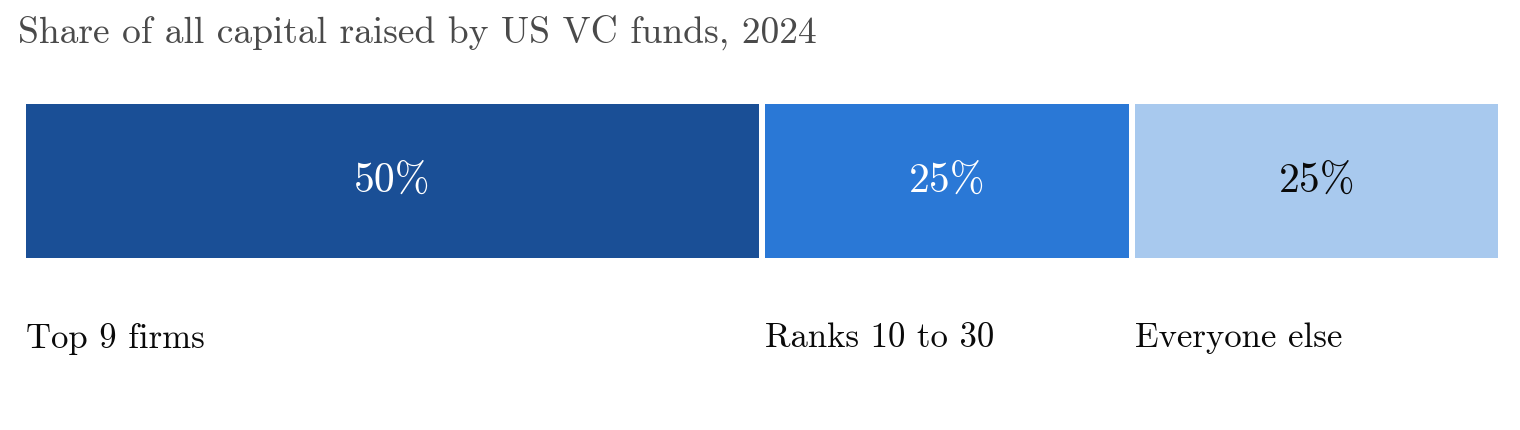
Overall, these funds also have the best returns. In many cases, if you can get into a round led by one of these firms, you are almost guaranteed to get a markup on the next round. They are also where the money now goes. In 2024, according to PitchBook, nine firms collected half of every dollar raised by US venture funds.
And this is the problem. The incentives of VC have fundamentally drifted away from their core.
Venture capital is supposed to be about underwriting risk. But if your strategy is, “I will invest once a Tier 1 fund invests,” you are not really underwriting the company anymore. You are underwriting the Tier 1 fund’s judgement.
Why has that become such an attractive strategy? Let’s look at the economics of the venture firms themselves. A typical venture fund charges a management fee and then takes carried interest on the profits of the fund. Right now the standard VC firm is raising 2.5 and 25. That means that 2.5% of the fund’s dollars is going to “management” every year, which is essentially into the pockets of the venture capitalists. Plus, they get 25% of whatever the fund makes. Oh, and that 2.5% is for every year of the 10-year fund term.
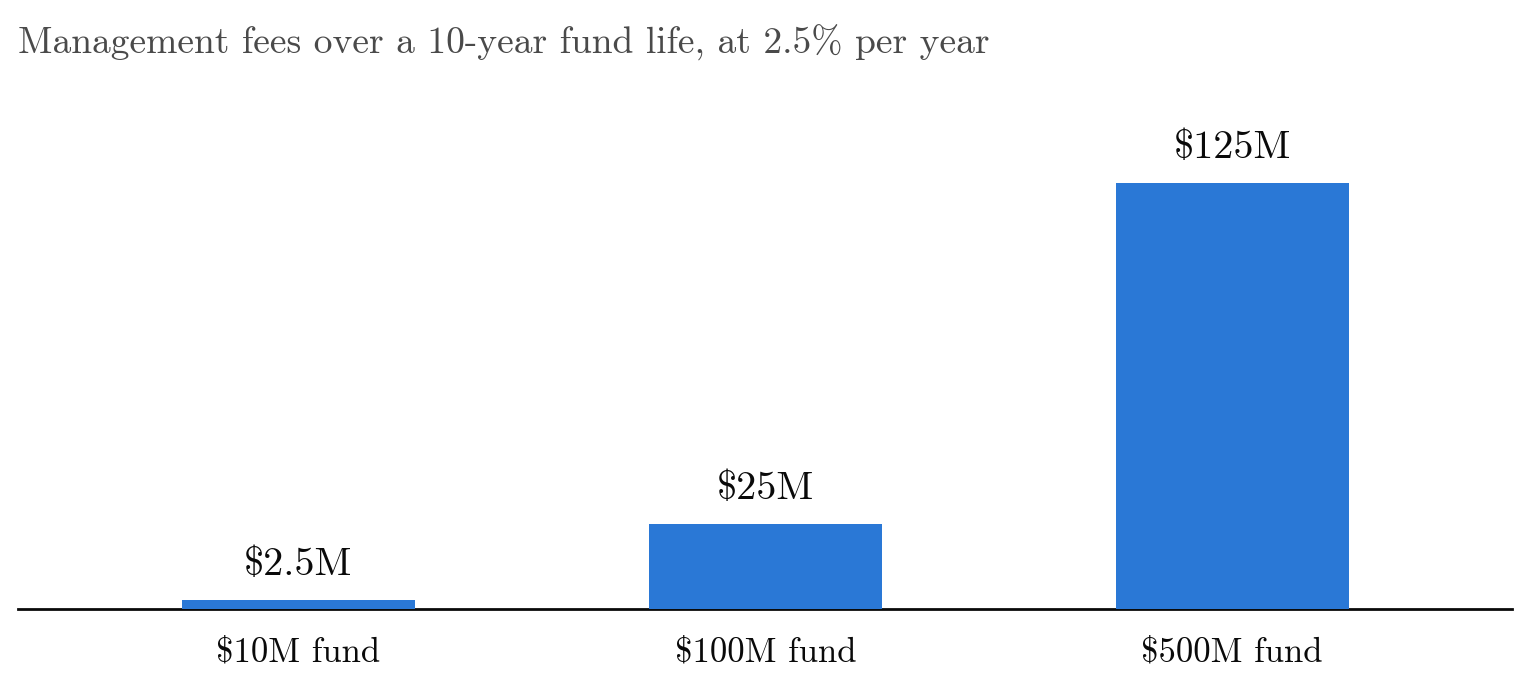
That is before a single dollar of carry, and it is the same team doing the same work in every row.
This has led to a change where the main driver of venture has not become the performance of the fund, but the ability to raise multiple, large funds. If you have a huge hit, you get your carry. But if you can raise a $100 million fund, then another $200 million fund, then a $500 million fund, you also build a very substantial management-fee business. This creates an incentive where the ability to raise the next fund can become nearly as important as the actual performance of the current one.
So if you’re running a fund that isn’t a Tier 1 fund, what do you do? You try to follow onto Tier 1-funded rounds, so you get the nice reputation boost, the company gets more capital, and there’s almost guaranteed to be a future markup. Then you can go back to your LPs with a portfolio that appears to be performing phenomenally well and raise your next fund.
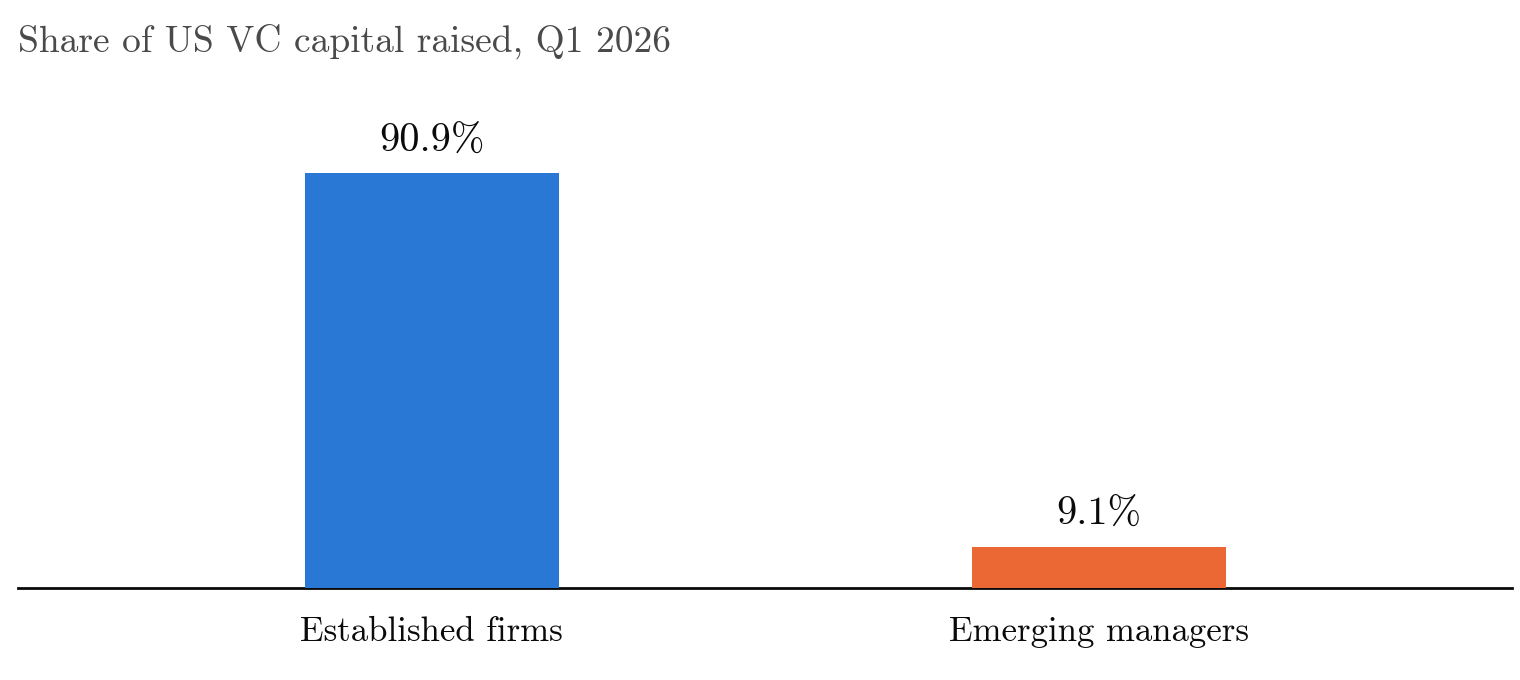
The trouble is that this is getting harder, not easier. In the first quarter of 2026, over 90% of the capital raised by US venture funds went to established firms. Only 177 emerging-manager funds closed in all of 2025, the lowest count since 2015.
Well, founders and the Tier 1 funds caught on. Look at the recent rounds at Starcloud and Valar Atomics. Both founders raised in tranches, with a Tier 1 leading the first tranche and buying equity at a specific price, and a second follow-on tranche at a much higher valuation.
Some people found this outrageous, but what’s important here is that the first investor and the second investor are buying different things. The first investor is buying the company. The second investor is buying the company plus all the gains from being part of a round led by a Tier 1.
This leads to second-order effects, which essentially reinforce the power laws of VC. Let’s look at Sequoia. If they invest in a company, and then, one month later, follow-on investors buy shares at three times the valuation, Sequoia’s investment will on paper look like it is growing faster than Anthropic. (And good for them, as they are doing all the work.)
This creates a powerful feedback loop. The best funds get access to the most promising companies, their investment causes other investors to invest at higher valuations, those valuations improve the funds’ paper returns, which leads them to raise larger funds and have even more power to win the next great company.
What this changes
Two things are about to come to a head. First, IRR and other measures heavily influenced by paper markups will stop being the main way we measure a fund’s performance. Distributions to paid-in capital, or what a fund actually returns to its LPs, will be the dominating measure going forward. And on that measure the picture is bleak. Here is Carta’s median net DPI by vintage as of the first quarter of 2026.
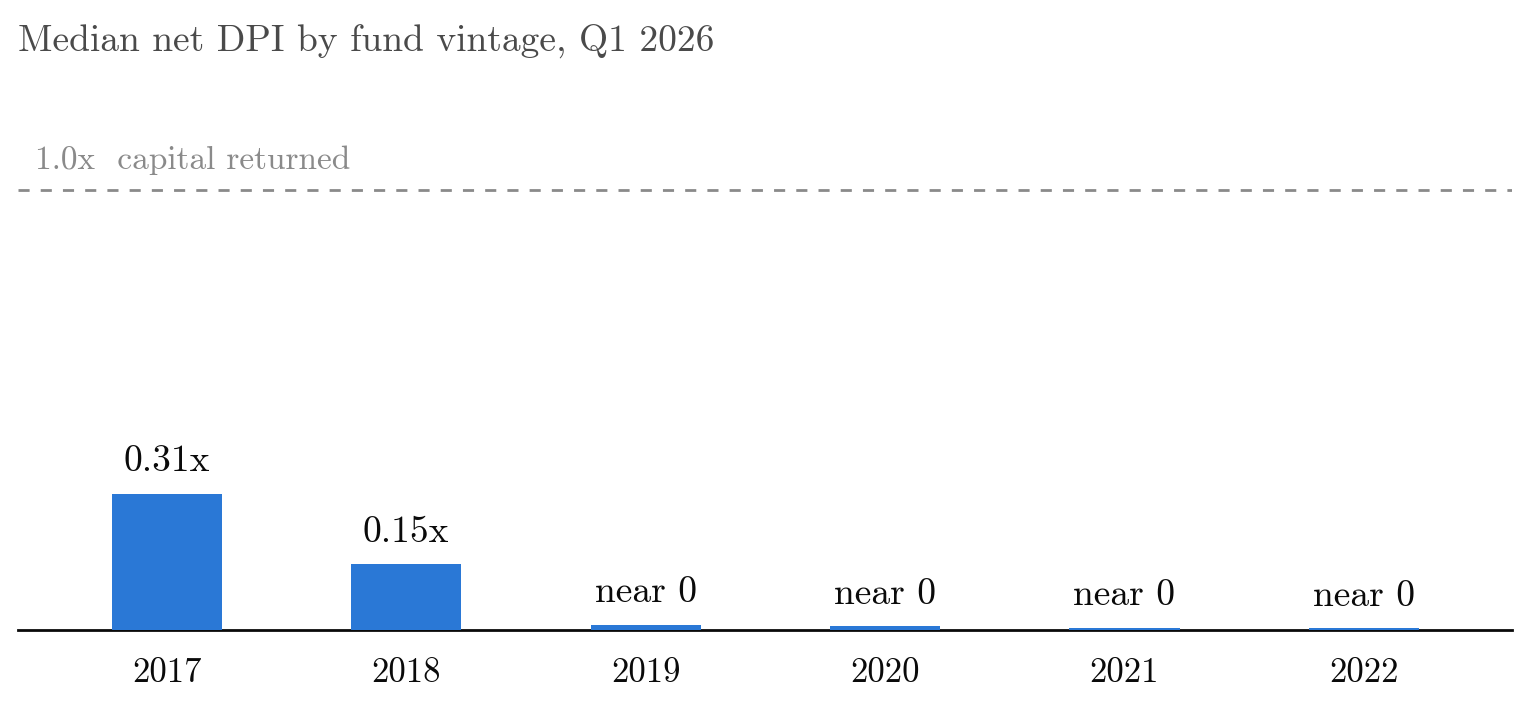
Fewer than 20% of the 2017 and 2018 funds have returned 1x. Only 42% of 2020 funds have distributed anything at all. Nine years in, the median fund from the best of these vintages has given back thirty cents on the dollar.
Second, if you are not willing to take a risk, you will die. This notion of “we only follow on to a16z” is not a sustainable venture strategy. It will kill a fund faster than anything else.
Gone are the days when you can assume you will get into a great company at the same price as the investor who actually did the work. Neither the founder nor the lead investor has any reason to give that away. If your strategy is to wait until somebody else has conviction, you will now be expected to pay for that conviction at a higher multiple.
— Matt
Comments